 Watch on YouTube
When is a bigger creative bet worth taking?
A hit can dominate attention and still tell you very little about the money an investor receives. This reading sequence separates four questions: why a company concentrates its bets, how its sector earns money, what reaches the accounts, and whether the market is pricing the right thing. Start with Elberse’s argument, use Vogel to map the business, use Epstein to challenge the headline, then use Lewis to question the valuation.
The books are not four versions of the same advice. Their different units of analysis—a portfolio, a sector, a film’s economics and an undervalued player—are what make the comparison useful. The applications below are Media CFO’s synthesis of our reviews, not a claim that each author endorses the others.
1. Ask what scale buys
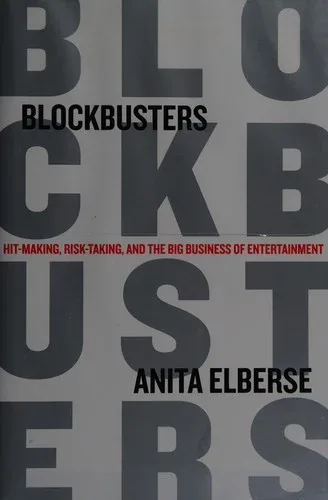
Read: Blockbusters, by Anita Elberse. Our review describes her argument that concentrated investment can make sense in entertainment because attention is scarce, consumption is social and scale can strengthen a release. Her cases challenge the assumption that many small bets are automatically safer.
That is a claim to test against a business, not permission to make any expensive project. Ask what the larger commitment buys: stronger distribution, a credible event, an audience relationship or simply more cost. A company must also be able to survive the unsuccessful outcome. The illustrative exercise below makes that last distinction visible without pretending to estimate a real film’s probability of success.
2. Identify the business behind the hit
Read: Entertainment Industry Economics, by Harold L. Vogel. Vogel’s usefulness here is the sector structure: revenue mechanics, costs, financing and accounting. A cinema ticket, a subscription and a licensing receipt are different economic events. Before comparing hits, identify who pays whom and what the reporting number includes.
Use the relevant chapter as a checklist rather than borrowing another sector’s margins. Our review also stresses content capitalisation, amortisation, royalties and participations. Those questions explain why an audience measure, recognised revenue and cash received need not move together. For current accounting rules or a transaction, check the applicable current sources; the guide does not turn a historical book example into a current standard.
3. Follow the receipts beyond the headline
Read: The Hollywood Economist 2.0, by Edward Jay Epstein. Our review values his account of downstream revenue and the charges that can separate a successful release from a participant’s payment. His home-video and pay-television examples belong to the business of the period he describes. Keep that historical boundary: they are a prompt to investigate today’s rights and receipts, not a current revenue forecast.
The enduring reading habit is to ask which number you are looking at. Audience spending is not automatically distributor revenue; distributor revenue is not automatically producer cash; producer cash is not automatically a payment under a participation agreement. The film finance collection’s worked participation statement follows those deductions in more detail.
4. Ask whether everyone is bidding for the wrong attribute
Read: Moneyball, by Michael Lewis. The review’s central lesson is to value the attribute that contributes to the outcome rather than the asset that looks impressive. Oakland’s baseball problem provides the example; it does not supply a ready-made metric for films or music.
This is a useful tension with Blockbusters. Elberse asks why paying for scale or established talent can be rational. Lewis asks where accepted valuation misses something useful. Both questions belong in an investment discussion. A low price is not evidence of mispricing, and a high price is not evidence that the attention it buys will pay back. Write down the mechanism and the evidence that could disprove it.
Four books, four different tests
| Book | What it helps you test | What it cannot decide alone |
|---|---|---|
| Blockbusters | Whether scale strengthens the route to an audience. | Whether this particular large bet is affordable or well priced. |
| Entertainment Industry Economics | How the sector’s money and accounting work. | Whether audiences will want a specific project. |
| The Hollywood Economist 2.0 | What sits behind reported success and contractual earnings. | What a present-day agreement will actually pay. |
| Moneyball | Whether the accepted valuation metric misses useful performance. | Whether a baseball measure transfers to entertainment. |
From the archive: the outlet changes the agreement
In his 2019 interview, Lindsay Conner explains how technology changes the rights and business terms an agreement needs to address. That is a useful bridge between the books and a real deal: knowing where an audience watches is only the beginning; the agreement determines which rights and economic terms follow it.
The interview is historical, and this connection is an editorial selection rather than a guest book recommendation. For another view of the same problem, read the archived essay Why streamers spend billions on original content with its original publication context.
Exercise: separate the average from the loss you must survive
Consider an invented project requiring $10 million of total upfront cash. Assume two mutually exclusive outcomes: a 25% chance of $30 million returned to this investor and a 75% chance of $2 million returned. These receipts are assumed net of all project costs and third-party deductions other than the investor’s original $10 million. All cash comes back one year later. The probabilities and amounts are teaching assumptions, not industry data or a forecast.
| Outcome | Assumed chance | Cash returned | Gain or loss after initial $10m |
|---|---|---|---|
| High outcome | 25% | $30m | +$20m |
| Low outcome | 75% | $2m | −$8m |
| Probability-weighted average | 100% | 0.25 × $30m + 0.75 × $2m = $9m | −$1m |
On those assumptions, a spectacular high outcome does not make the average attractive: $9 million returned is less than the $10 million paid. The high-outcome probability would have to reach 2/7, approximately 28.6% for an undiscounted break-even: $2m + p × ($30m − $2m) = $10m. Financing costs, investor tax and the required return on capital are excluded; allowing for them would raise the hurdle. A probability-weighted average is not cash available to pay bills, and the low outcome still loses $8 million.
Now change one assumption at a time. What evidence supports a higher probability? Does an extra marketing commitment raise the cost as well as the potential receipts? Is the investor entitled to the receipts you modelled? Could the company withstand the low outcome? Elberse frames the scale question; Vogel and Epstein force the revenue and deduction questions; Lewis challenges the evidence used to price the bet.
Finally, compare a portfolio of smaller projects only after writing down their costs, outcomes and relationships to each other. Several projects exposed to the same buyer or audience shock may fail together. This two-outcome example does not prove that concentrating or diversifying is generally better; it shows which assumptions a comparison needs.
Where to go next
Use Running a creative company for the team and decision process behind the investment. Use the distribution guide to map rights and release windows, then the collection account guide to follow money that has actually arrived.
Explore the four full reviews through the covers above, or browse all book reviews.