
 Watch on YouTube
Every other book on this list tells you a story. This one tells you the numbers.
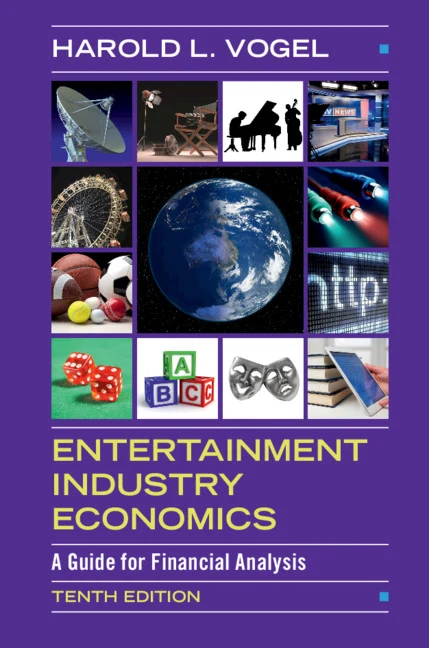
Entertainment Industry Economics has been in print since 1986 and is now in its tenth edition. It is not a narrative, it does not have a thesis, and nobody has ever read it on a beach. It is the reference work for the financial analysis of entertainment — and if you finance, value or advise anything in this sector, it is the book on the shelf you will actually reach for.
What the book actually covers
The scope is the point. Film, music, television, advertising, broadcasting, cable, casinos and wagering, publishing, arts and culture, the performing arts, toys and games, sports, and theme parks — each treated as an economic sector with its own revenue mechanics, cost structures, accounting conventions and financing patterns.
For each, Vogel works through how money actually moves: how a film is financed and how the participations are calculated, how residuals and royalties are structured, what the accounting treatments are and where they diverge from intuition, how the capital markets have historically priced these businesses.
The tenth edition adds material on streaming services, on the relationship between demographics and entertainment spending, on electromagnetic spectrum for broadcasters, and — for anyone who has ever had to explain film amortisation to a bank — on the revised FASB rules for film and television.
It is roughly seven hundred pages with several hundred more of references. It is a reference book and behaves like one.
Why you should read it
Read it if you are ever the person in the room who has to say what something is worth. There is no substitute for this book. The trade press gives you narrative, the memoirs give you anecdote, and this gives you the structure underneath both.
Read it if you cross sectors. Most people in entertainment know their own vertical and guess at the others. Vogel's real service is that the chapters are built to the same template, so you can read the music chapter with a film analyst's eye and see immediately where the economics differ and where they rhyme.
Read it, above all, for the accounting. Entertainment accounting is genuinely peculiar — revenue recognition, capitalisation and amortisation of content, participations and residuals — and it is where most outside investors get into trouble. Vogel treats it as a first-class subject rather than an appendix, which almost nobody else does.
A practical note. Buy the current edition and do not economise on an older one. The whole value of the book is that the figures, the accounting rules and the sector structures are current, and this is a field where a decade-old edition will actively mislead you on streaming and on content amortisation.
Key takeaways
- Entertainment is not one industry. It is a dozen sectors with genuinely different economics, and the book's structure is an argument for treating them separately.
- The accounting is where the risk hides. Content capitalisation and amortisation decide what a business appears to earn, and the rules have moved.
- Cross-sector patterns are visible if you look. The uniform chapter structure is what makes the comparison possible, and the comparison is where the insight is.
- Reference beats narrative when money is involved. Every other book here explains what happened. This one lets you work out what something is worth.
Meet the author

Harold L. Vogel spent seventeen years as senior entertainment industry analyst at Merrill Lynch, and was ranked the top entertainment analyst by Institutional Investor for ten consecutive years — a record in the category. He holds a PhD in financial economics and is a chartered financial analyst.
He has taught media economics as an adjunct professor at Columbia Business School in New York and at Cass Business School in London, and formerly served on the New York State Governor's Motion Picture and Television Advisory Board. He now heads an independent investment and consulting firm in New York.
Entertainment Industry Economics was first published by Cambridge University Press in 1986 and has been revised roughly every three to four years since. He is also the author of Travel Industry Economics, a companion volume, and Financial Market Bubbles and Crashes.
That combination — a sell-side analyst who became an academic economist and kept revising the same book for forty years — is why this is the standard reference rather than merely a good one.
Get your copy
Entertainment Industry Economics
Where the proceeds go
Some book links on this site earn a commission. Every penny of it goes to the American Cancer Society.
The American Cancer Society funds cancer research, runs free patient-support programs, provides lodging for patients traveling for treatment, and staffs a 24-hour helpline. You do not need to buy a book to help.
This review contains affiliate links. As an Amazon Associate I earn from qualifying purchases, and all commission is donated — details on my disclosure page.