
 Watch on YouTube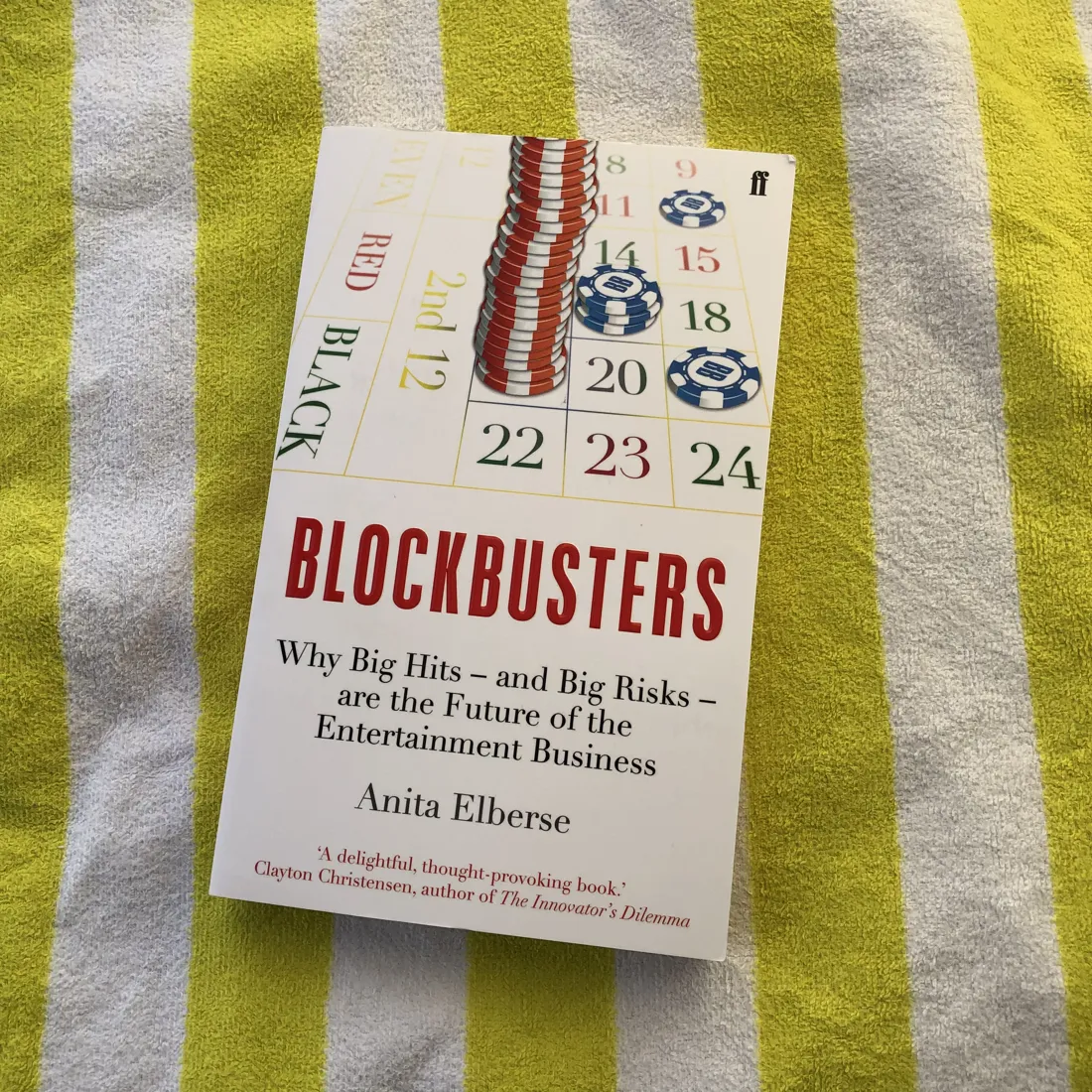
Everything you were taught about diversification is wrong in this one industry, and Anita Elberse has the numbers to prove it.
That is a large claim, so here is the evidence she opens with. In 1999 Alan Horn took over as president of Warner Bros. Out of roughly twenty-five films a year, he picked four or five and gave them a wildly disproportionate share of the production and marketing budget. Meanwhile Jeff Zucker at NBC Universal did the sensible thing — managed for margin rather than ratings, spread the risk, kept costs down.
Warner became the first studio to take a billion dollars at the domestic box office eleven years running. NBC went from first place to fourth.
What the book actually covers
Blockbusters is a direct refutation of Chris Anderson's The Long Tail, and Elberse says so plainly. Anderson's 2006 argument was that digital distribution would erode the dominance of hits: infinite shelf space means consumers drift toward niches, and the money moves into the tail. It was enormously influential and, Elberse argues, wrong.
Her position is that concentration is the rational strategy, not the reckless one. In a market saturated with choice, attention is the scarce good, and only genuine events command it. The small bet is not the safe bet — it is the bet that reliably produces a small outcome, and in an industry where returns are distributed by winner-take-all mathematics, small outcomes do not cover the portfolio.
She is a trained econometrician and the book is built on cases rather than assertion: Warner Bros. and NBC, Real Madrid's policy of paying top dollar against Barcelona's academy model, Grand Central Publishing staking $1.25 million on an unknown author, Lady Gaga's launch, YouTube's $300 million experiment in original programming, Marvel, the NFL, Jay-Z, LeBron James.
The marketing logic underneath is worth extracting. Scale buys advantages that do not exist at smaller budgets, and consumption in entertainment is social — people choose what they can discuss with others, which mechanically concentrates demand. Betting on the A-list star is not vanity spending. It is risk reduction.

Why you should read it
Read it if you allocate capital across a portfolio of creative projects. That is the entire book, and it will make you uncomfortable in a useful way.
Read it also because the argument has escaped entertainment. The Wall Street Journal noted that the blockbuster logic now describes consumer markets from restaurants to hotels to electronics — anywhere attention is scarce and outcomes are power-law distributed. If you work in venture, that description will sound extremely familiar.
One note on timing. The book is from 2013, which in business publishing is usually a warning. This one has aged in the opposite direction. Streaming consolidation, the franchise economics that now govern the studios, and the increasing scarcity of attention have all moved toward Elberse's argument rather than away from it. It reads today less like a prediction and more like a description.
Key takeaways
- Concentration is risk management, not risk appetite. The distribution of outcomes in entertainment means the small bet is the one that cannot pay for the portfolio.
- Attention is the constraint, not shelf space. Digital distribution removed the shelf limit and made attention scarcer, which strengthened the hits rather than weakening them.
- Consumption is social. People choose what they can talk about with others, and that mechanically concentrates demand at the top.
- Elberse's own summary is the line to remember: the idea that smaller bets are safer is a myth.

Meet the author

Anita Elberse is the Lincoln Filene Professor of Business Administration at Harvard Business School, and one of the very few academics whose work is read as seriously inside the entertainment industry as within it.
She trained as an economist and econometrician, and the Wall Street Journal once described her approach as bringing to entertainment the statistical rigour that sabermetricians brought to baseball. She has published more than four dozen case studies on entertainment companies and figures — Beyoncé, David Beckham, Lady Gaga, Jay-Z, LeBron James, Sir Alex Ferguson — and her research centers on what actually drives success in creative industries and how firms should manage products and talent inside them.
Blockbusters, published in 2013 by Henry Holt, was her first book. It grew directly out of the case work rather than sitting alongside it, which is why the examples carry more detail than is usual in the genre.
Get your copy

Blockbusters
Where the proceeds go
Some book links on this site earn a commission. Every penny of it goes to the American Cancer Society.
The American Cancer Society funds cancer research, runs free patient-support programs, provides lodging for patients traveling for treatment, and staffs a 24-hour helpline. You do not need to buy a book to help.
This review contains affiliate links. As an Amazon Associate I earn from qualifying purchases, and all commission is donated — details on my disclosure page.