 Watch on YouTube
Here is a fact that reorganises how you read every box-office number you will ever see: for most of the modern studio era, the ticket sales were never where the money was.
Edward Jay Epstein spent years reverse-engineering the actual financial machine behind the movies, and The Hollywood Economist is the result — a short, sharp, faintly disreputable guide to where the money in film really comes from, where it really goes, and why almost none of it works the way the public, or even most people in the industry, assume.
What the book actually covers
Epstein's method is forensic. He came to Hollywood as an investigative journalist — his earlier work dismantled the Warren Commission and exposed the diamond cartel — and he treats the studios the same way: follow the money, distrust the narrative, find the real ledger.
The findings are a sequence of small demolitions. Theatrical release, he argues, functions largely as a marketing event for the revenue streams that actually matter — at the time of writing, home video, pay television and licensing. A film could lose money in cinemas and still be enormously profitable, and the theatrical number that dominates the press is close to a vanity metric.
He is superb on studio accounting, which is where the book earns its place on a finance shelf. The mechanics by which a film grossing hundreds of millions can show a contractual loss — the distribution fees, the interest, the overhead charges layered onto a production's books so that net-profit participants receive nothing — are laid out clearly enough to be genuinely useful. This is the creative accounting that produces the famous outcome where a blockbuster is, on paper, a failure.
The 2.0 edition adds the MGM saga — how a consortium of hedge funds lost billions on the studio — the emergence of prestige pay-TV as a working business model while the studios chased teenagers, and the collapse of independent film distribution over the preceding five years.
Why you should read it
Read it to inoculate yourself against the reported number. Epstein's central service is teaching you that box office is a marketing statistic, not a financial one, and that the real economics sit downstream in windows the press rarely covers. For anyone modeling or assessing a film business, that recalibration is fundamental.
Read it for the accounting chapters specifically. Hollywood net-profit accounting is a genuine dark art, and Epstein's plain-language walk through how a hit becomes a paper loss is more instructive than most formal treatments, because he is interested in the mechanism rather than the euphemism.
And read it as the popular companion to Harold Vogel's textbook, also covered here. Vogel gives you the rigorous, comprehensive version; Epstein gives you the fast, sceptical, journalist's version. Read Epstein first — he is more fun and will make you want the detail Vogel provides.
Key takeaways
- Box office is a marketing metric. The reported gross is close to a vanity number; the real money historically sat in the downstream windows the press ignores.
- A hit can be a contractual loss. Distribution fees, interest and overhead charges are layered onto a film's books until net-profit participants receive nothing. Understand the mechanism before signing anything with "net" in it.
- The windows are the business. Home video, pay television and licensing did the financial work that theatrical merely advertised.
- Follow the money, distrust the narrative. Epstein's investigative habit is the transferable one — the reported story about a film's economics is almost never the real one.
Meet the author

Edward Jay Epstein was an American investigative journalist and a former political science professor at Harvard, UCLA and MIT. He first came to notice as a graduate student in 1966 with Inquest, an influential critique of the Warren Commission, and went on to write on subjects as varied as the diamond cartel, the KGB and CIA, and, later, the Edward Snowden affair.
He wrote the "Hollywood Economist" column for Slate, which became this book, and the earlier The Big Picture: Money and Power in Hollywood. His approach to the film industry was consistent with the rest of his career: he assumed the official account was incomplete and went looking for the real numbers.
He was born in New York in 1935 and died there on 9 January 2024, aged eighty-eight. His scepticism was his method, and the film books are that scepticism applied to an industry that rewards it.
Get your copy
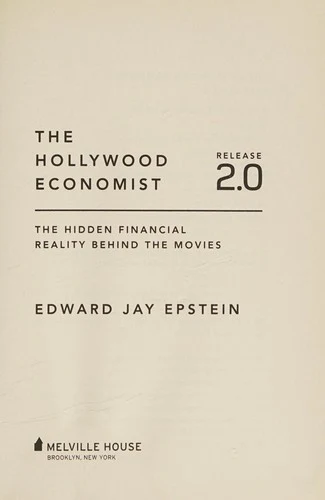
The Hollywood Economist 2.0
Where the proceeds go
Some book links on this site earn a commission. Every penny of it goes to the American Cancer Society.
The American Cancer Society funds cancer research, runs free patient-support programs, provides lodging for patients traveling for treatment, and staffs a 24-hour helpline. You do not need to buy a book to help.
This review contains affiliate links. As an Amazon Associate I earn from qualifying purchases, and all commission is donated — details on my disclosure page.