
 Watch on YouTube
There are two Geffen biographies on this shelf and neither was welcome. Tom King's The Operator, covered here, is the long one — 670 pages, built on access that Geffen granted and then withdrew. Stephen Singular's is the earlier, shorter, faster book, and it arrived first.
Read it as the reconnaissance. King's is the full survey.
What the book actually covers
Singular traces the same trajectory King would later cover at greater length: the William Morris mailroom, the fabricated résumé that got him in, Asylum Records, the sale to Warner, the return with Geffen Records, and the emergence of a figure with unusual leverage across music and then film.
What makes Geffen worth studying is not the taste — plenty of people had taste — but the structural cleverness. He understood earlier than most that in a business built on artists, the person who controls the contracts and the catalog captures more of the value than the person who makes the records. He sold Asylum, watched it appreciate, and structured the next one better. The pattern of building, selling, and re-entering on improved terms is the through-line.
Singular is working from the outside. Geffen did not cooperate, and the book is assembled from interviews with people around him and from the public record. That gives it the strengths and limitations of the form: it is quick, it is unbeholden, and it is thinner on the interior than a book with access would be.
Why you should read it
Read it as the short version. If you want the Geffen career arc without committing to King's 670 pages, this delivers the structure of the story efficiently. For a reader who wants to understand why Geffen matters commercially, that may be sufficient.
Read it for the serial-builder pattern. Asylum, then Geffen Records, then DreamWorks — three ventures, each structured better than the last, each sold or scaled from a stronger position. That is a repeatable method rather than a run of luck, and it is the transferable content here.
And read it as the counterpoint in a set. Two unauthorised biographies of the same man, written years apart with different access and different intentions, plus Michael Ovitz's own memoir covering the same era and many of the same rooms. Reading unauthorised accounts against each other is a diligence exercise, and this shelf lets you run it properly.
Key takeaways
- Control the contracts, not just the talent. Geffen's consistent insight was that the value sits with whoever holds the rights and the agreements.
- Build, sell, re-enter on better terms. The serial pattern across Asylum, Geffen Records and DreamWorks is the method, and it improved each time.
- Unauthorised has its own value. No access means no obligations, which produces a different and sometimes more useful book.
- Read it against the longer one. Singular is the sketch; King is the portrait. The gap between them is informative.
Meet the author

Stephen Singular (1950–2024) was an American non-fiction author who wrote extensively in the true-crime and investigative-biography space, with a long list of titles across several decades. His approach here is journalistic assembly rather than archival scholarship — interviews, public record, and the reporting of what people around the subject were willing to say.
The Rise and Rise of David Geffen was published in the 1990s, before Tom King's more comprehensive account, and was among the first attempts to write seriously about a figure who had actively discouraged the exercise.
Get your copy
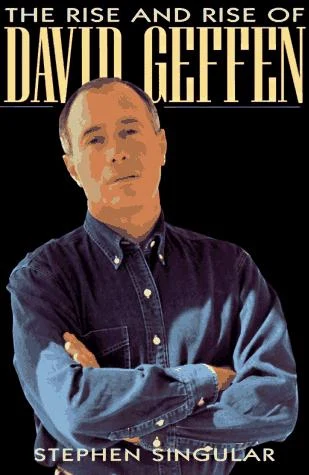
The Rise and Rise of David Geffen
Where the proceeds go
Some book links on this site earn a commission. Every penny of it goes to the American Cancer Society.
The American Cancer Society funds cancer research, runs free patient-support programs, provides lodging for patients traveling for treatment, and staffs a 24-hour helpline. You do not need to buy a book to help.
This review contains affiliate links. As an Amazon Associate I earn from qualifying purchases, and all commission is donated — details on my disclosure page.