 Watch on YouTube
Splitting the difference feels fair. It is how reasonable people end an argument, and it is how a great many deals get done.
Chris Voss's title is an instruction, and his argument for it is a pair of shoes. If you want black and I want brown, meeting in the middle gets us one of each. Nobody is served. The compromise felt like fairness and produced an outcome neither party would have chosen.
He spent twenty-four years at the FBI, much of it as its lead international kidnapping negotiator. In that job you do not split the difference, because there is no version of half a hostage.
What the book actually covers
Voss's central move is to reject the idea that negotiation is a rational exercise between two parties optimising. People are emotional, they are inconsistent, and they are mostly trying to feel understood. His term for working with that rather than against it is tactical empathy — not being nice, but demonstrating that you have accurately grasped the other side's position, which lowers their guard far more effectively than any argument.
The techniques are specific and immediately usable:
Mirroring. Repeat the last few words your counterpart said, as a question. They elaborate. You learn something. It is almost embarrassingly simple and it works on nearly everyone.
Labeling. Name the emotion in the room before it does damage. It seems like this timeline is a problem for you. Saying it defuses it; leaving it unsaid lets it drive the negotiation from underneath.
Calibrated questions. Replace demands with questions beginning how or what. How am I supposed to do that? hands the problem to the other side while giving them the illusion of control, and is very hard to answer aggressively.
"That's right" is the goal, not "you're right." When someone tells you that you are right, they are ending the conversation. When they say that's right, they have recognized themselves in your summary. Only one of those is progress.
No is the beginning. Voss argues against chasing yes, which makes people defensive. A counterpart who has been allowed to say no feels safe, and safety is where movement starts.
And underneath all of it, the black swans: the hidden pieces of information that reframe an entire negotiation once surfaced. Most of the work is finding them.
Why you should read it
Read it because the techniques survive contact with ordinary business. Most negotiation writing is either academic or anecdotal; this is a field manual, and mirroring works as well on a supplier as it did on a bank robber.
Read it if you tend to over-prepare your own position and under-prepare theirs. The book's real argument is that the leverage sits in what you can get the other side to tell you, and nearly every technique in it is a device for making someone talk.
Read it alongside Igor Ryzov's The Kremlin School of Negotiation, which I have also covered here, because the two books disagree in an interesting way. Voss believes the person across the table can be moved by being understood. Ryzov assumes some of them are simply measuring how much you will surrender. Both are right, at different tables, and knowing which one you are sitting at is most of the skill.
Key takeaways
- Compromise is not fairness. Splitting the difference reliably produces an outcome neither party actually wanted.
- Tactical empathy is a tool, not a temperament. You are not being kind. You are demonstrating comprehension, which is what lowers a counterpart's defenses.
- Aim for "that's right." It signals that your counterpart has recognized themselves in your account. "You're right" usually means they want the conversation to stop.
- The information you need is on their side of the table. Mirroring, labeling and calibrated questions are all mechanisms for getting it across.
Meet the author

Christopher Voss served twenty-four years with the Federal Bureau of Investigation, beginning as a SWAT officer and rising through the New York hostage negotiation ranks to become the bureau's lead international kidnapping negotiator and a key figure on the New York City Joint Terrorism Task Force.
Born in Mount Pleasant, Iowa, he took his bachelor's degree at Iowa State and a master's in public administration at Harvard's Kennedy School. In 2008 he moved to the private sector and founded the Black Swan Group, which has since become the negotiation consultancy of choice for a long list of Fortune 500 companies.
Never Split the Difference: Negotiating As If Your Life Depended On It was published in 2016 by Harper Business, co-written with the journalist Tahl Raz. It has since become one of the small handful of business books that people actually keep on the desk rather than the shelf.
Get your copy
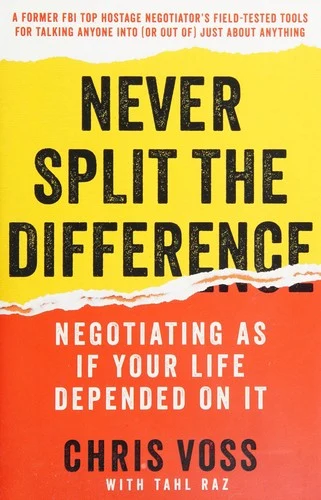
Never Split the Difference
Where the proceeds go
Some book links on this site earn a commission. Every penny of it goes to the American Cancer Society.
The American Cancer Society funds cancer research, runs free patient-support programs, provides lodging for patients traveling for treatment, and staffs a 24-hour helpline. You do not need to buy a book to help.
This review contains affiliate links. As an Amazon Associate I earn from qualifying purchases, and all commission is donated — details on my disclosure page.