
 Watch on YouTube
Give a team of business school students a set of spaghetti and marshmallows and ask them to build the tallest possible tower. Now give the same task to a team of kindergarteners.
The children win, consistently. Not because they are smarter, but because they skip the status negotiation entirely. They stand shoulder to shoulder, try things, fail visibly, and adjust. The students spend most of their time working out who is in charge.
Daniel Coyle uses that experiment to open an argument about what actually makes groups work, and the answer is not talent.
What the book actually covers
Coyle studied groups that consistently outperform — special forces units, a world-class surgical team, an improv comedy company, a jewel thief crew, sports teams — looking for what they share. His conclusion is three skills, built in sequence.
Build safety. Groups perform when members are confident they belong, and belonging is transmitted through small, frequent, almost invisible signals: proximity, eye contact, turn-taking, the physical language of attention. Coyle's account of these belonging cues is the book's most original material. They are not warmth for its own sake — they are the mechanism by which a person becomes willing to contribute honestly.
Share vulnerability. Cooperation is built through mutual admission of limitation, and crucially the leader has to go first. Coyle's examples of leaders opening with what they do not know, or with their own error, are the counter-intuitive core.
Establish purpose. High-performing groups are relentlessly, almost embarrassingly repetitive about what they are for. Coyle argues the repetition is the point — purpose is not communicated once and understood, it is a signal that must be transmitted continuously.
Each section closes with concrete practices, which keeps it from becoming inspirational.
Why you should read it
Read it if you join teams rather than build them. Coyle's framework explains why the first hour in an existing group determines the next six months, and what specifically to do in it. For anyone working on a fractional or interim basis, that is the operationally useful part.
Read it for the vulnerability-first finding, which is the one most leaders get backwards. The instinct on entering a group is to demonstrate competence. Coyle's evidence is that demonstrating limitation first is what produces candour from everyone else — and candour is what makes the group work.
And read it against No Rules Rules, covered here. Netflix's doctrine says raise talent density and then demand candour. Coyle says candour is a product of safety, and safety is built through specific behaviors that have to come first. Both are describing the same problem from different ends, and the disagreement about sequencing is worth thinking through.
Key takeaways
- Safety precedes performance. Belonging cues are the mechanism, and they are small, frequent and mostly non-verbal.
- Vulnerability has to start at the top. The leader admitting limitation first is what licenses honesty from everyone else.
- Purpose is transmitted by repetition. High-performing groups say what they are for constantly, and the repetition is the mechanism rather than a failure of communication.
- The first hour sets the terms. For anyone entering an existing team, the belonging signals sent early determine what follows.
Meet the author

Daniel Coyle is an American journalist and author who writes about how skill and performance are actually developed. His earlier book The Talent Code examined deliberate practice and the neurological basis of skill acquisition, drawing on visits to what he called talent hotbeds — places producing disproportionate numbers of high performers.
The Culture Code: The Secrets of Highly Successful Groups, published in 2018, applies the same reporting method to group performance rather than individual skill. He has also worked as an advisor with professional sports organizations, which gives the material a practitioner grounding.
Get your copy
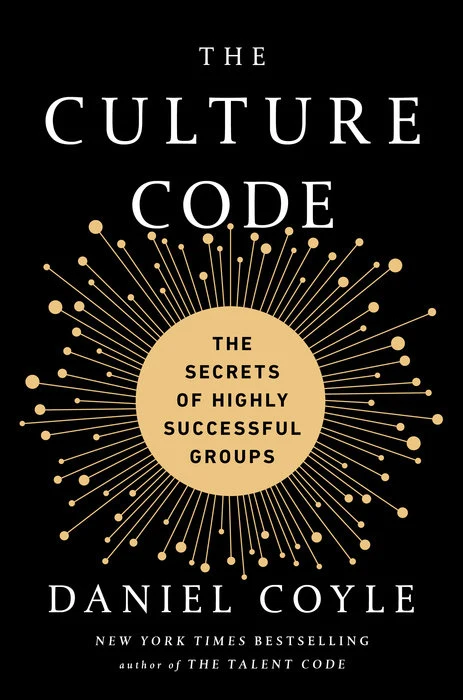
The Culture Code
Where the proceeds go
Some book links on this site earn a commission. Every penny of it goes to the American Cancer Society.
The American Cancer Society funds cancer research, runs free patient-support programs, provides lodging for patients traveling for treatment, and staffs a 24-hour helpline. You do not need to buy a book to help.
This review contains affiliate links. As an Amazon Associate I earn from qualifying purchases, and all commission is donated — details on my disclosure page.