
 Watch on YouTube
Netflix's culture deck circulated a million and a half times before anyone wrote a book about it. Sheryl Sandberg called it one of the most important documents to come out of Silicon Valley. It was a slide deck.
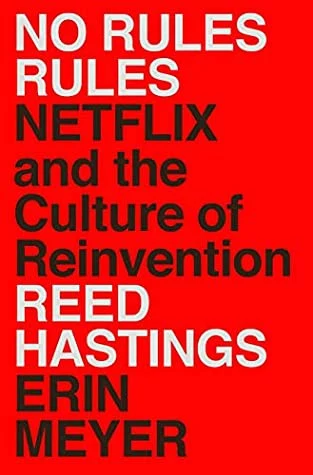
No Rules Rules is the long-form version, and it is unusual for a corporate culture book in that it was written with someone whose job is to disagree with it.
What the book actually covers
The doctrine has a sequence, and Hastings is clear that the order matters. First, raise talent density — because a team of exceptional people needs fewer rules. Then increase candour, so that the exceptional people tell each other the truth. Only then remove controls: no holiday policy, no expense approvals, decision-making pushed down.
The famous mechanisms follow from that. Pay at the top of the market rather than issuing bonuses, on the reasoning that bonuses distort behavior toward whatever is measured. Do not tolerate adequate performance — the "keeper test" asks a manager whether they would fight to retain someone, and if the answer is no, that person should be paid to leave. Give people context rather than instructions. And the phrase that did the most damage in transmission: the company is a team, not a family.
The structural cleverness of the book is Erin Meyer. She is an INSEAD professor who studies how business behavior differs across cultures, and Hastings brought her in to interrogate the doctrine rather than endorse it. She researched Netflix's international offices and reports, in her own voice, where the model broke — radical candour landing very differently in Tokyo than in Amsterdam, the "team not family" framing reading as callous in markets where employment is understood differently.
That makes it the rare culture book with a built-in adversary. It is considerably better for it.
Why you should read it
Read it for the sequencing argument, which is the part most imitators miss. Companies read this book and remove their expense policy. That is step three. Without the talent density and the candour underneath it, removing controls produces chaos rather than freedom, and Hastings says so explicitly.
Read it for Meyer's chapters if you operate across Europe and the US. Her material on how the same management practice reads in different labor cultures is directly useful, and it is the section a German or Dutch reader will find most immediately recognisable.
And read it with the keeper test held at arm's length. It is the most consequential idea here and the one with the highest human cost. Hastings is candid that generous severance is what makes it defensible. Whether it is defensible in jurisdictions where employment protection is a legal structure rather than a company policy is a genuinely open question, and one Meyer raises.
Key takeaways
- The sequence is the doctrine. Talent density first, candour second, controls removed third. Reversing the order is how this fails.
- Context, not control. Managers are expected to give people enough information to decide well, rather than approving decisions.
- The keeper test is the engine and the cost. Everything else in the model depends on it, and it is the part that does not travel.
- Culture is not universal. Meyer's contribution is the empirical demonstration that the same practice produces different results in different countries.
Meet the authors


Reed Hastings co-founded Netflix in 1997 with Marc Randolph, became its chief executive, and led it through the transitions from DVD-by-post to streaming to original production. He stepped back from the co-chief executive role in 2023 and became executive chairman. Before Netflix he founded the software company Pure Software, an experience he describes as formative largely because of what went wrong.
Erin Meyer is a professor at INSEAD, where she specialises in cross-cultural management, and the author of The Culture Map — which is worth reading independently and is arguably the more broadly useful of her two books. Her role here was to test the Netflix model against her own research rather than to write it up.
No Rules Rules was published in 2020.
Get your copy
No Rules Rules
Where the proceeds go
Some book links on this site earn a commission. Every penny of it goes to the American Cancer Society.
The American Cancer Society funds cancer research, runs free patient-support programs, provides lodging for patients traveling for treatment, and staffs a 24-hour helpline. You do not need to buy a book to help.
This review contains affiliate links. As an Amazon Associate I earn from qualifying purchases, and all commission is donated — details on my disclosure page.