 Watch on YouTube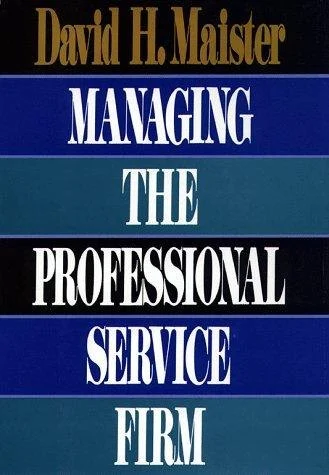
Most business books are written about companies that make things. This one is written about firms that sell judgement — where the assets go home at night, the product is a person's attention, and the thing being priced is trust.
If you run an advisory practice, a law firm, an agency, a consultancy or any business where clients are buying expertise rather than output, this is the book. It was published in 1993 and nothing has replaced it.
What the book actually covers
Maister's organizing insight is that a professional service firm is a system with three variables that must balance: the type of work you take, the mix of people you need to do it, and the economics that result. He calls the work types brains, gray hair and procedure — problems nobody has solved before, problems you have solved before, and problems that can be systematised. Each requires a different leverage structure, a different pricing model, and a different kind of person.
Most firms get into trouble by mixing these without noticing. A practice built on brains work cannot be staffed like a procedure practice. A firm that has drifted from brains to procedure and kept brains pricing will lose clients; one that has drifted the other way and kept procedure staffing will lose money.
From there the book works through the practical machinery. How partner compensation shapes behavior, usually badly. Why the highest-return marketing activity is almost always with existing clients rather than new ones, and why nearly every firm does the opposite. What professionals actually want from a career, and what happens when a firm's promotion structure and its economics disagree. How to price. How to manage people whose leaving costs you a client relationship.
The tone is unusual for the genre — Maister is direct to the point of bluntness, particularly about partners, and the book has almost no motivational content in it at all.
Why you should read it
Read it if you sell your own expertise. Maister's central argument is that the economics of a professional firm are not intuitive: the profitable move is frequently the opposite of the obvious one, and firms fail at scale because they scale the wrong variable.
Read it if you are deciding whether to build a firm or stay solo. This is the best available account of what actually changes when you add people, and it is unsentimental about the fact that many excellent professionals make poor firm-builders because the two require different things.
And read it for the client-relationship material, which is the part with the widest application. Maister's argument that firms systematically under-invest in the clients they already have is one of those observations that seems obvious once stated and is nearly universally ignored. His later book with Charles Green and Robert Galford, The Trusted Advisor, develops it into a full framework and is the natural follow-on.
Key takeaways
- Brains, gray hair, procedure. The type of problem you solve determines your staffing, your leverage and your pricing. Mixing them without noticing is the standard failure.
- Existing clients are the highest-return marketing spend. Almost every firm knows this and almost none behaves accordingly.
- Compensation is strategy. How partners are paid determines what the firm actually does, regardless of what the strategy document says.
- Growing is not the same as getting better. Maister is unusually clear that scale changes the business into a different business, and that this is a choice rather than a natural progression.
Meet the author

David H. Maister spent his career on the professional service firm as a subject, which was an unfashionable specialism when he chose it and is now a field.
He was a professor at Harvard Business School in the early 1980s before leaving to work independently, and spent the following decades advising firms across law, accounting, consulting, architecture, advertising and finance. He held degrees from Birmingham, the London School of Economics and Harvard.
Managing The Professional Service Firm was published in 1993 and remains the standard text. He also wrote True Professionalism, Practice What You Preach, Strategy and the Fat Smoker, and — with Charles H. Green and Robert M. Galford — The Trusted Advisor, which is the most widely read of his books and the best entry point if this one looks daunting.
He announced his retirement from active consulting and speaking some years ago, having spent a career telling partners things they did not want to hear.
Get your copy
Managing The Professional Service Firm
Where the proceeds go
Some book links on this site earn a commission. Every penny of it goes to the American Cancer Society.
The American Cancer Society funds cancer research, runs free patient-support programs, provides lodging for patients traveling for treatment, and staffs a 24-hour helpline. You do not need to buy a book to help.
This review contains affiliate links. As an Amazon Associate I earn from qualifying purchases, and all commission is donated — details on my disclosure page.