 Watch on YouTube
Most contracts in film and television are signed by people who are not lawyers. A writer optioning a first script, a producer signing a distribution deal, an actor taking a day-player deal: each of them signs paper that someone else's business affairs department drafted with care, and many of them sign it without anyone on their side having read it closely.
Mark Litwak, a Santa Monica entertainment attorney who has been a lawyer since 1977, wrote this book for those people. He calls it the first "self-defense" book for everyone working in the film and television industry, and the fourth edition backs that up with 25 sample contracts, 27 case summaries and a glossary, in a book addressed to readers who are not lawyers.
What the book actually covers
The book follows the life of a project from the first conversation to the last dispute. After an introduction to the American film industry, it turns to dealmaking itself (the types of contracts and the types of deals) and then moves through the rights a production needs before it can shoot: permission to portray real people and places, clearance of rights, and the literary acquisition agreements that secure a book, an article or a script, from the option to the purchase to the shopping agreement.
The middle of the book deals with the people. Employment contracts for writers, directors, actors, producers and crew sit alongside loan-out companies and WGA credit arbitration, and a separate chapter gives advice addressed to writers, directors and actors, down to the director's cut. Music has its own chapter, and so does distribution, which covers borrowing against pre-sales, four-wall releases and new media distribution.
A finance reader will spend the most time with two chapters that sit side by side. Negotiating Tactics and Strategies covers the techniques that induce a studio to make a deal, and Creative Accounting walks through the "tricks of the trade" in profit statements, using Art Buchwald's lawsuit against Paramount over Coming to America to show how a hit can report no net profit to the people promised a share of it. The back half of the book covers copyright, the First Amendment and the right of publicity, defamation, privacy, trademarks and remedies, and it closes with the practical question of how to retain an attorney, an agent or a manager.
The 25 sample agreements are what earn the book its place on a desk. They include depiction releases, a location agreement, an option and literary purchase agreement and a shopping agreement, employment agreements for writers, directors, actors and a line producer, a collaboration agreement, a submission release, a television synchronization license, a low-budget composer agreement, and home video and international distribution agreements. Litwak writes in plain American English, and he explains the fine print in these forms and why it is necessary, which is what a non-lawyer needs before signing one.
Why you should read it
Read it if you sign deals in film and television without a business affairs department behind you. That describes most independent producers, most writers and directors early in their careers, and a fair number of financiers who come to the industry from somewhere else. Litwak steers the reader clear of the contractual traps in each kind of deal, and that knowledge makes every hour with a lawyer more productive once you do hire one.
Read it if you invest in or lend to productions. The sections on chain of title, clearance and errors and omissions insurance describe what a financier's counsel checks before money moves, and a CFO who understands them can spot a problem in a deal memo weeks before it reaches the lawyers. The sample distribution agreements repay the same attention, because the definitions in them decide what a sales estimate is actually worth.
And read it next to Schuyler Moore's The Biz, covered here. Moore writes from the financing and tax side of the industry and Litwak from the side of the talent and the independent producer, so the two books together cover most of the tables a producer will sit at.
Key takeaways
- Read every draft as the other side wrote it. Each form in circulation was drafted to protect somebody, and the first job is to work out who that is.
- Chain of title comes first. A production that cannot prove it owns its underlying rights cannot be insured, financed or distributed, however good the film turns out to be.
- Net profit is a contractual definition. What a participation pays depends on how the contract defines the pool, and that definition is negotiated long before anyone sees a statement.
- Choose your representatives with the same care as your cast. Litwak gives a whole chapter to retaining attorneys, agents and managers, and the person negotiating for you shapes every deal that follows.
Meet the author

Mark Litwak has been a lawyer since 1977, has practiced in New York and California, and runs the Law Offices of Mark Litwak & Associates in Santa Monica. He works as a producer's representative and expert witness, and his biography lists work on more than 200 feature films as well as production counsel work on the Netflix series The Baby-Sitters Club and Wet Hot American Summer. He has also served as an arbitrator on the entertainment panels of the American Arbitration Association and the Independent Film & Television Alliance.
Teaching has run alongside the practice. He began teaching a course on movie industry dealmaking at the USC Gould School of Law in 2013, he taught entertainment law at UCLA Extension for more than twenty years, and he has also taught at Loyola Law School and the University of Puget Sound School of Law.
Dealmaking in the Film & Television Industry first appeared from Silman-James Press in 1994 and won the Kraszna-Krausz Moving Image Book Award in 1995. The second edition followed in 2002, the third in 2009 and the fourth in 2016, which added more than 100 pages of new material on changes such as the growth of Netflix and YouTube and brought the legal rulings up to date. His other books include Reel Power (1986), Courtroom Crusaders (1989), Contracts for the Film & Television Industry and Risky Business: Financing & Distributing Independent Films.
Get your copy
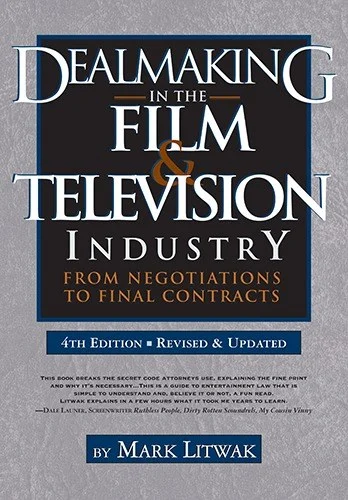
Dealmaking in the Film & Television Industry
Where the proceeds go
Some book links on this site earn a commission. Every penny of it goes to the American Cancer Society.
The American Cancer Society funds cancer research, runs free patient-support programs, provides lodging for patients traveling for treatment, and staffs a 24-hour helpline. You do not need to buy a book to help.
This review contains affiliate links. As an Amazon Associate I earn from qualifying purchases, and all commission is donated — details on my disclosure page.