 Watch on YouTube
Maurice Micklewhite was a working-class boy from Rotherhithe with a Cockney accent at a time when English film acting required you not to have one. He spent years being told, in various polite formulations, that people like him did not do this.
He is now Sir Michael Caine, with two Academy Awards, a career spanning six decades and something close to 160 films. This is the book he wrote about how.
What the book actually covers
It is a memoir organized as advice, which is a harder form than either alone. Caine works through the career chronologically and pulls a lesson from each stage, and the lessons are unusually concrete because the failures were.
The famous one is "use the difficulty." He tells it as a rehearsal note: an actor complains that a chair is blocking the door he has to enter through, and is told to use the difficulty — come in angry about the chair. It has become a management aphorism, and it survives that treatment better than most because the underlying instruction is specific. The obstacle is material. Work with what is actually in the room.
The professional advice is the best of it. Learn your lines so thoroughly that you can stop thinking about them. Do not blink on camera — it reads as weakness. Continue acting after the line is delivered, because the reaction is where the scene lives. Turn up on time, know the crew's names, be someone people want to hire again. Most of this is about reliability rather than talent, which is a fairly pointed thing for a two-time Academy Award winner to emphasize.
He is honest about the fallow decades. There were long stretches of bad films taken for money, and he does not pretend otherwise — the Jaws sequel gets the line about never having seen the film but having seen the house it built, which is either brutally honest or a very well-polished joke, and probably both.
Why you should read it
Read it for the class material, which is the serious argument under the anecdotes. Caine broke into an industry with an explicit gatekeeping mechanism — the voice — and did it by refusing to change it. The book is unsentimental about how much of a career is determined by who is permitted to have one.
Read it for the professionalism. Strip out the film specifics and what remains is a manual on being someone others choose to work with repeatedly over decades. That transfers to any field where the work is project-based and reputation compounds.
And read it for the late-career chapters, which are the least expected. Caine's post-seventy run — Nolan, the character work, the second reputation — is a genuine study in how a career can be rebuilt after the phase everyone assumed was the end.
Key takeaways
- Use the difficulty. The obstacle in the room is material to work with, not an argument for stopping.
- Reliability compounds faster than brilliance. Turning up prepared, on time, and pleasant to work with is what produces a sixty-year career.
- Do not sand off the thing that makes you identifiable. The accent was the barrier and then it was the asset. He never changed it.
- The reaction is the scene. Keep working after your line lands — a note that applies well beyond acting.
Meet the author

Sir Michael Caine was born Maurice Micklewhite in south London in 1933 and served in the British Army in Korea before turning to acting. He spent most of the 1950s in repertory and small parts before Zulu in 1964 and The Ipcress File and Alfie established him.
He has won two Academy Awards, both for supporting roles, in Hannah and Her Sisters and The Cider House Rules, and has worked continuously across six decades, including an extended late-career collaboration with Christopher Nolan. He was knighted in 2000.
Blowing the Bloody Doors Off: And Other Lessons in Life was published in 2018. The title refers to The Italian Job, which he was not especially fond of at the time and which has outlived most of the films he preferred.
He announced his retirement from acting in 2023, at ninety, and has since published fiction — which is a fairly Caine-like response to retiring.
Get your copy
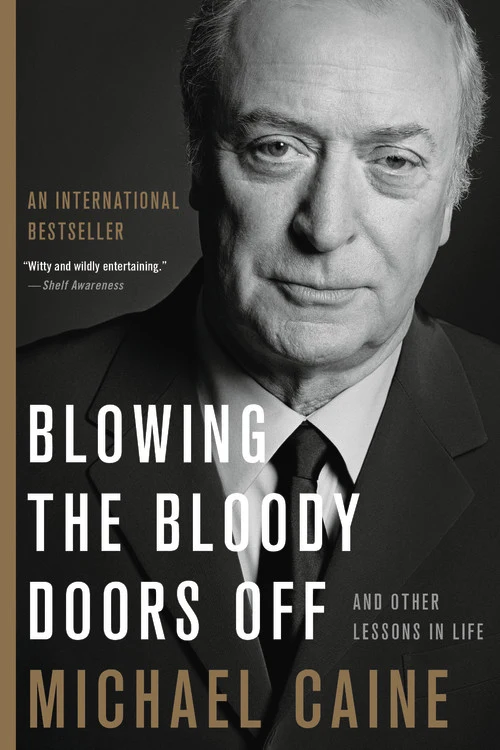
Blowing the Bloody Doors Off
Where the proceeds go
Some book links on this site earn a commission. Every penny of it goes to the American Cancer Society.
The American Cancer Society funds cancer research, runs free patient-support programs, provides lodging for patients traveling for treatment, and staffs a 24-hour helpline. You do not need to buy a book to help.
This review contains affiliate links. As an Amazon Associate I earn from qualifying purchases, and all commission is donated — details on my disclosure page.