
 Watch on YouTube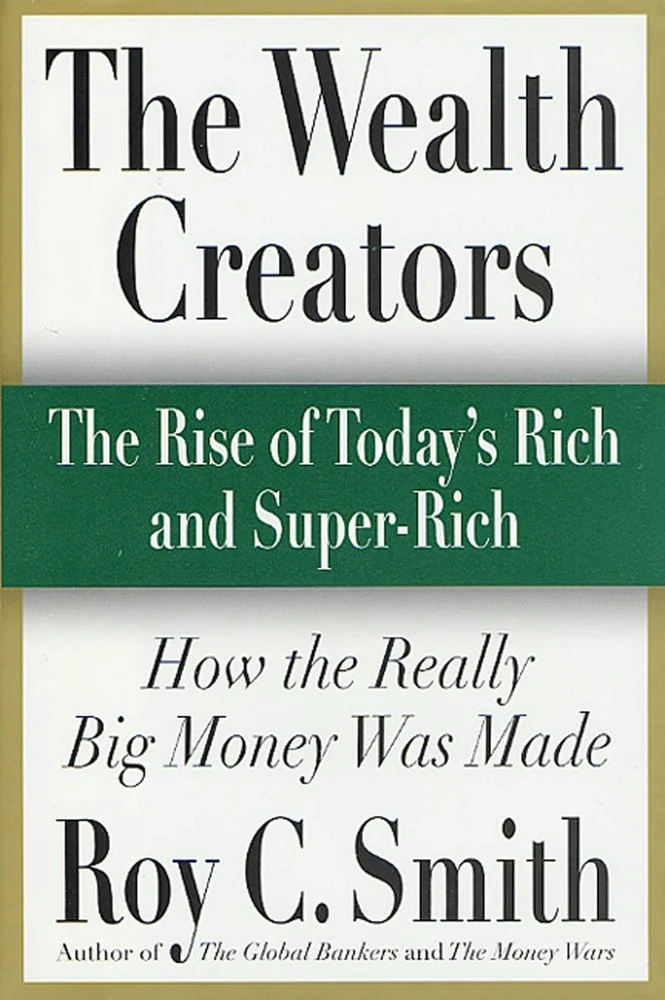
The data in this book is anchored to the beginning of 2000. Nearly three hundred billionaires in the United States, five million millionaires, total household wealth of thirty-seven trillion dollars — up from just over eight trillion when Reagan took office.
That is the peak of the dot-com bubble, measured to the month. Within two years a great deal of that wealth had evaporated, and within a decade several of the men Roy Smith holds up as exemplars had been removed, discredited, or bailed out.
Which makes this a far more interesting book to read now than it was to read then.
What the book actually covers
Smith's structure is a taxonomy. He sorts the very rich into five categories and explains the economics of each before working through individual cases.
Entrepreneurs — Bloomberg, Walton, Turner. Dealmakers — Kerkorian, Perelman, Tisch. Investors and financiers — Buffett, Soros. Corporate executives — Welch, Weill, Eisner. Entertainers — Winfrey, Spielberg, Tiger Woods.
The method is what distinguishes it from the genre. Smith is not interested in temperament or morning routines. He wants the mechanism. The Sandy Weill entry does not simply note that he made his money in stock options — it works through the reload provision in his contract and what that provision was actually worth. The Michael Jordan section ignores the basketball entirely and argues statistically about why his endorsement value was priced where it was.
That is an investment banker's book, and the blurb from Martin Mayer makes the point exactly: it is written from an investment banking perspective, and investment bankers are the people who know how these things were structured.
The underlying argument is that the social and economic shifts of the late 1970s opened a window in which enormous fortunes became possible, and that his subjects are extreme instances of a broad trend rather than freaks.
What happened next
Since the book is a snapshot, it can be checked against what followed. Three of his corporate executives are instructive.
Jack Welch was, in 2000, the most admired manager in the world and the book treats him accordingly. His reputation has since been substantially reassessed — the earnings management, the pension accounting, the fate of GE Capital, and the eventual dismantling of the company he built. The consensus on Welch in 2026 is not the consensus of 2000.
Sandy Weill built Citigroup into the model financial conglomerate. It required one of the largest government rescues in history in 2008. Weill later publicly argued that the separation of investment and commercial banking he had spent his career dismantling should be restored.
Michael Eisner was ousted from Disney in 2005 after a shareholder revolt — a revolt substantially about the governance issues that Smith's dealmaker chapters are, elsewhere in the book, quite sympathetic to.
That is not a criticism of Smith's analysis. His mechanisms were correct: these men did make their money the way he says they did. What the intervening quarter-century demonstrates is something the book could not have known — that the mechanism of wealth creation and the durability of the enterprise are separate questions, and this book only measures the first.
Why you should read it
Read it for the structural argument, which has held. Smith's claim that the late-1970s shift created a window, and that his subjects are extreme cases of a broad pattern, looks better now than most of what was written about wealth at the time.
Read it for the mechanisms. The specificity is the value — the option reload provision, the endorsement pricing, the deal structures. This is what the money actually was, described by someone who had structured that kind of thing professionally.
And read it as a period document, in the same way as the Fehrenbach on this shelf. A book written at a peak, by a serious person, about people who were about to be tested. That is a genuinely useful thing to hold, provided you know that is what you are holding.
Key takeaways
- Wealth has categories, and the economics differ by category. The entrepreneur, the dealmaker and the executive are not making money the same way, and conflating them produces nonsense.
- The mechanism is in the contract. Smith's discipline of going to the actual structure — the option terms, the deal architecture — is the transferable habit.
- Creating wealth and building something durable are different achievements. Several of his exemplars did the first spectacularly and the second not at all.
- Read the date on the cover. Any book about wealth is a snapshot, and this one was taken in an unusually revealing month.
Meet the author
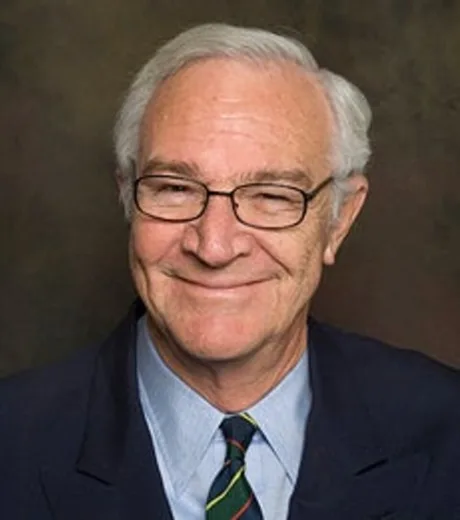
Roy C. Smith graduated from the US Naval Academy in 1960 and took an MBA at Harvard in 1966, the year he joined Goldman Sachs. He became a general partner in 1976 and ran Goldman Sachs International from London between 1980 and 1984, retiring from the firm in 1987 as its senior international partner. He remained a limited partner until the firm went public in 1999.
He then joined the faculty of NYU's Stern School of Business, where he spent thirty years — as the Kenneth Langone Professor of Entrepreneurship and Finance for eighteen of them, and latterly as Emeritus Professor of Management Practice. He retired in 2017. He also lectured at INSEAD, IESE in Barcelona, Bocconi in Milan and NYU Abu Dhabi.
He wrote prolifically and was among the most-quoted academic voices on financial events, as well as co-authoring Global Banking and Capital Markets with Ingo Walter, which became a standard text.
He died in November 2019, aged eighty-one.
Get your copy
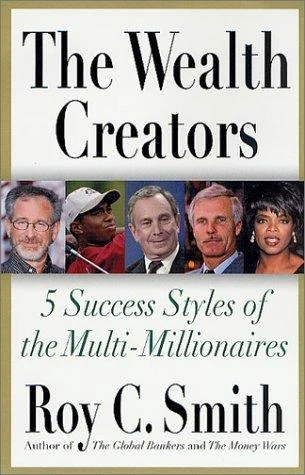
The Wealth Creators
Where the proceeds go
Some book links on this site earn a commission. Every penny of it goes to the American Cancer Society.
The American Cancer Society funds cancer research, runs free patient-support programs, provides lodging for patients traveling for treatment, and staffs a 24-hour helpline. You do not need to buy a book to help.
This review contains affiliate links. As an Amazon Associate I earn from qualifying purchases, and all commission is donated — details on my disclosure page.