
 Watch on YouTube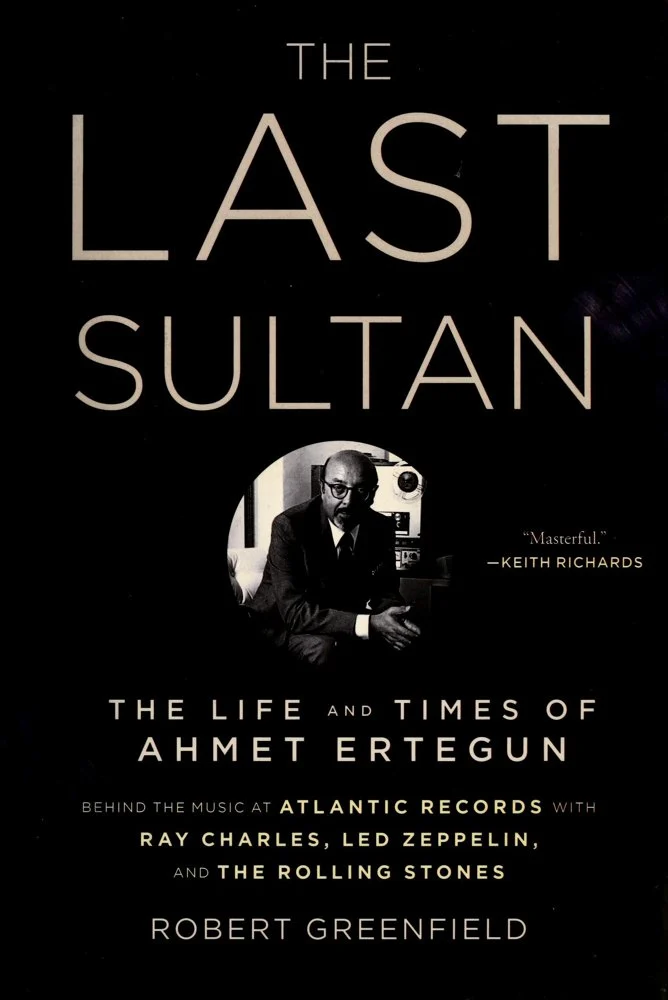
Ahmet Ertegun was the son of the Turkish ambassador to Washington. He grew up in embassies, spoke several languages, collected art, and moved through the highest end of international society for sixty years.
He also founded Atlantic Records, signed Ray Charles and Aretha Franklin and Led Zeppelin, and spent his working life in a business that Fredric Dannen would later document as being substantially run by racketeers.
Both things are true simultaneously, and Robert Greenfield's biography is the book that holds them together.
What the book actually covers
Ertegun founded Atlantic in 1947 with a loan from the family dentist. He was in his early twenties, a jazz and blues obsessive with a diplomat's manners and an outsider's ear, and what he had that his competitors did not was taste plus the willingness to sit in the studio and work.
Greenfield traces the whole arc: the early rhythm and blues years, Ray Charles, the Atlantic–Stax arrangement that put Aretha Franklin in Muscle Shoals, the pivot into British rock with Led Zeppelin and the Rolling Stones, the sale to Warner and the decades operating inside a corporate structure while behaving as though he were still running an independent.
The biography is unauthorised in the useful sense — Greenfield had extensive access to people around Ertegun but was not writing a monument. He is direct about the drinking, the womanising, the deals that were less generous to artists than the legend suggests, and the long twilight in which Ertegun became a social fixture as much as a record man.
What emerges is a man of genuine cultivation operating with real ruthlessness, and Greenfield does not resolve that tension because it does not resolve.
Why you should read it
Read it for the A&R question, which is the one every media investor eventually asks: can taste be systematised? Ertegun's answer, implicitly, is no — he signed on instinct, in rooms, over decades, and nobody at Atlantic could replicate it after him. That is a genuine problem for anyone valuing a business built on a single person's judgement.
Read it for the corporate chapter. The sale to Warner and what followed is a case study in what happens to a founder-led creative business inside a conglomerate: the money is better, the autonomy is negotiated annually, and the culture survives exactly as long as the founder is personally protecting it.
And read it against Hit Men. Dannen's book documents the industry Ertegun operated in during the same decades — the promoters, the payola, the organized crime. Greenfield's Ertegun is charming and cultured and was there the whole time. Reading them together is the honest way to do it, and considerably more interesting than either alone.
Key takeaways
- Taste did not scale. Atlantic's competitive advantage was one man's ear, which is an asset with no succession plan.
- The founder is the culture, and the culture ends with them. The Warner years show how long a creative culture survives inside a conglomerate: as long as the founder personally defends it.
- Charm is an operating capability. Ertegun's social access was not decoration — it was how he got to artists, and how he kept them.
- Cultivation and ruthlessness are not opposites. The book's refusal to reconcile them is its strongest quality.
Meet the author

Robert Greenfield is one of the most experienced music biographers working, and came to it from primary reporting rather than from criticism. He was an associate editor at Rolling Stone in its London bureau in the early 1970s, which put him inside the period he has spent much of his career writing about.
His books include S.T.P.: A Journey Through America with the Rolling Stones, an account of the 1972 tour written from inside it; a biography of Jerry Garcia; Bill Graham Presents, written with the concert promoter; and Timothy Leary: A Biography. He is a reporter first, and the books are built on interviews rather than on secondary sources.
The Last Sultan: The Life and Times of Ahmet Ertegun was published in 2011, five years after Ertegun's death.
Get your copy
The Last Sultan
Where the proceeds go
Some book links on this site earn a commission. Every penny of it goes to the American Cancer Society.
The American Cancer Society funds cancer research, runs free patient-support programs, provides lodging for patients traveling for treatment, and staffs a 24-hour helpline. You do not need to buy a book to help.
This review contains affiliate links. As an Amazon Associate I earn from qualifying purchases, and all commission is donated — details on my disclosure page.