
 Watch on YouTube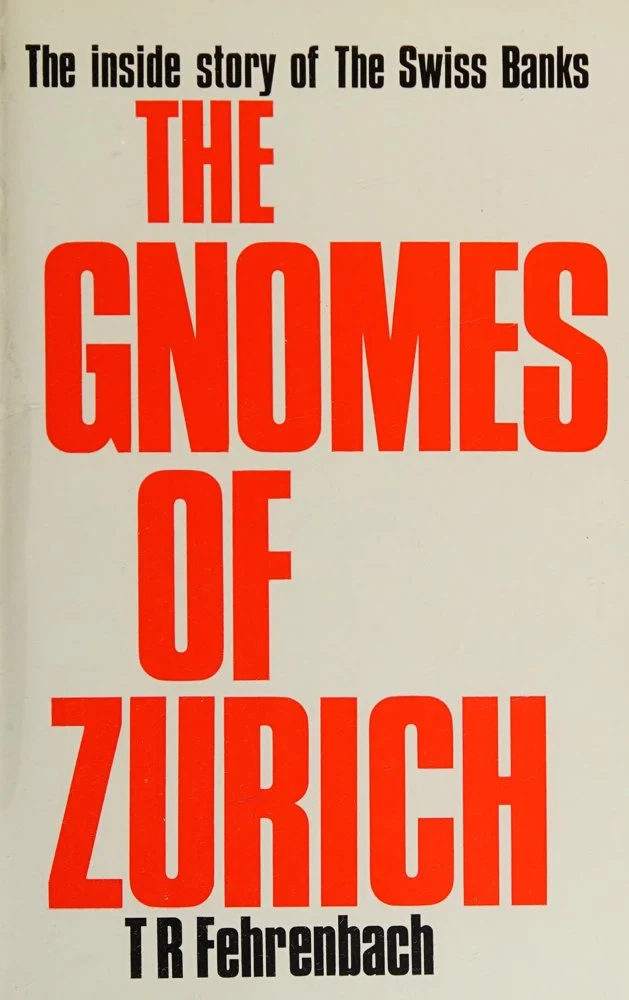
Let me be direct about this one, because it would be dishonest not to be.
The Gnomes of Zurich was published in 1966. It is a well-written, well-researched account of Swiss private banking, and its central subject — the numbered account, the secrecy statute, the discreet institution that would take your money and answer no questions about it — has been dismantled so completely that the book is now a historical document rather than a guide to anything.
That is precisely why it is worth reading. Not as instruction. As evidence.
What the book actually covers
Fehrenbach traces Swiss banking from the fourteenth century through to what was, in 1966, the present day. He covers the emergence of the private banks, the relationship between the banking cartel and the Confederation, the mechanics of the secrecy statute, and the institutions themselves — Swiss Bank Corporation, Union Bank, the Bankers Association, the old Geneva houses.
The reporting is genuinely good. He is thorough on the Second World War material — the German assets, the IG Farben and Interhandel arrangements, the gold — and on the postwar clientele. His index is a roll call of the era's money: Trujillo, the industrialists, the exiled royalty, the film people.
And running through it is his central image. The numbered account, he writes, is the most subtle and most sophisticated status symbol in the modern world. That framing tells you what the book is really about. Not tax efficiency. Status. The account was a luxury good, and its luxury was that it could not be looked into.
What happened next, and why it matters
The system Fehrenbach describes did not evolve. It was destroyed, and it happened within a single decade.
The crack was UBS in 2008 and 2009. A United States prosecution produced a deferred prosecution agreement, a substantial fine, and — the part that actually mattered — the handing over of client names. The unthinkable had been done once, which meant it could be done again.
Then came the infrastructure. The United States legislated FATCA in 2010, requiring foreign institutions to report on American account holders. Switzerland signed up to the OECD's common reporting standard, began collecting data in 2017, and started exchanging it automatically the following year. Not on request. Not on suspicion. Automatically, every year, to every participating tax authority.
That is the whole story. The gnome's product was informational asymmetry, and asymmetry cannot survive automatic exchange. No law banned Swiss banking. An information standard simply made the thing it was selling impossible to sell.
There is a lesson in that worth more than most of what is written about regulation. The business was not killed by prohibition. It was killed by plumbing.
Where the book has aged badly
I am going to say this plainly, because the alternative is to recommend the book while quietly stepping around it.
Fehrenbach writes about the wartime and postwar money with a detachment that does not survive contact with what came afterwards. He was writing in 1966, three decades before the Volcker Committee went through the dormant accounts and before the settlement with Holocaust survivors and their heirs in 1998. He did not know what would be found. But the register he uses — worldly, amused, faintly admiring of the discretion involved — reads very differently now that we know whose money some of it was and how long the institutions declined to look for the owners.
The same is true of the dictators. Trujillo is in this book as local color. He is not local color.
None of that makes it a bad book. It makes it a primary source written from inside a moral consensus that has since collapsed, which is a genuinely useful thing to read if you understand that is what you are holding.
Key takeaways
- Secrecy was the product. Not returns, not service, not expertise. The confidentiality was the thing being sold, which made the business fatally dependent on a single feature.
- Infrastructure beats legislation. Automatic exchange of information ended this industry without anyone outlawing it. Worth remembering the next time a business model depends on a gap that a data standard could close.
- Status was the demand driver. Fehrenbach is unusually clear that clients wanted the account partly for what having it meant. That is a market you cannot rebuild once it becomes embarrassing.
- Read it for 1966, not for now. Anyone using this as a guide to current Swiss practice would be sixty years out of date and headed for serious trouble.
Meet the author
Theodore Reed Fehrenbach was born in San Benito, Texas, in 1925, took his degree at Princeton in 1947, and served in the US infantry and engineers in the Second World War and then through the Korean War, rising from platoon leader to company commander and battalion staff officer with the 2nd Infantry Division.
He is not, in any meaningful sense, a banking writer. His enduring works are Lone Star, the one-volume history of Texas, This Kind of War, still regarded as one of the finest histories of the Korean conflict, and Fire and Blood, a history of Mexico. He was an authority on Texas, on Mexico and on the Comanche, headed the Texas Historical Commission from 1987 to 1991, and wrote a weekly column for the San Antonio Express-News for close to thirty years.
The Swiss material is a detour. He published two books on it in 1966 — this one and a companion — and then essentially never returned to the subject. That is worth knowing: this is a serious narrative historian applying his method to a foreign system for a couple of years, not a financial specialist writing his life's work.
He died in San Antonio on 1 December 2013, aged eighty-eight.
Get your copy
The Gnomes of Zurich
Where the proceeds go
Some book links on this site earn a commission. Every penny of it goes to the American Cancer Society.
The American Cancer Society funds cancer research, runs free patient-support programs, provides lodging for patients traveling for treatment, and staffs a 24-hour helpline. You do not need to buy a book to help.
This review contains affiliate links. As an Amazon Associate I earn from qualifying purchases, and all commission is donated — details on my disclosure page.