 Watch on YouTube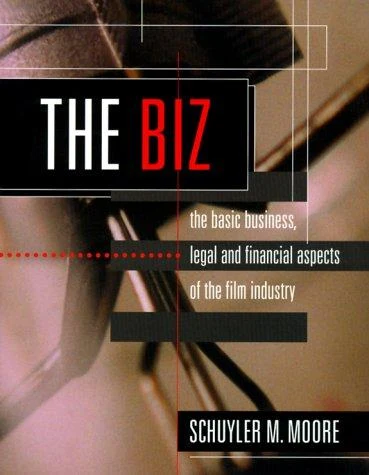
Most people who write the standard work on an industry love that industry. Sky Moore does not go to the cinema. He does not own a television. He told me, on the record, that he could not care less about the talent or the films — to him it is simply a business, and he would just as happily have done motorcycles if Los Angeles had had a motorcycle industry.
That detachment is exactly why The Biz is the best short book on how the film business actually works.
What the book actually covers
The Biz is the general volume. Moore's heavier work is Taxation of the Entertainment Industry, a treatise he updates every year with every relevant regulation, ruling and case — and which the IRS uses as a training book for its own entertainment group. Read that sentence again. The man who advises the industry on tax also wrote the manual the tax authority trains on.
The Biz is what he wrote for his students at UCLA, where he taught in both the law school and the business school and used it as the course textbook. It covers the business, legal and financial architecture of the film industry: how productions are financed and structured, what the distribution agreements actually do, how the money is accounted for, where the tax sits, and which entity choices determine all of it. The current edition is rebuilt for the digital world, which in practice means the streaming distribution chain rather than the theatrical one.
Its great virtue is compression. This is not seven hundred pages. It is the working architecture, written by someone whose entire professional method is to strip a transaction down to three questions — money in, money out, and control — and who teaches his students to be, in his phrase, special forces who can drop into any deal and find the load-bearing issues.
Why you should read it
Read it if you are structuring anything. Moore's recurring complaint about this industry is that it runs on handshake deal memos and one-page term sheets, and that this reliably ends in litigation. He does not permit his clients to do it. The book is, among other things, an argument for documenting properly the first time.
Read it especially if you invest into US film from outside. He described the same scene happening over and over: an international investor arrives the day before closing, having thought about none of the federal withholding, none of the state tax, and asks whether someone could just take a quick look. His example of the standard error is worth the cover price on its own — money accepted under a contract that says "investment" is not automatically equity, and if it has not been structured as a partnership or a corporation it can be an advance sale of income, taxable to the producer up front. Small companies make this mistake. Studios do not.
And read it as a corrective to every other book on this list. The memoirs give you the personalities. Vogel gives you the sector economics. Moore gives you the paperwork — which is where the money is actually won or lost.
The predictions, scored
Since I have the tape, it seems only fair to check the man's forecasts. In March 2019 he told me:
The death of theatrical for films under $100 million. He said the market had bifurcated, that films below that line were in serious trouble, and that he was personally sitting on client films he could not sell. Broadly right, and if anything he understated it.
A completely digital world, with a crowded field and a shakeout coming. Right. He named Disney–Fox, Warner–AT&T and Apple as the incoming players and predicted content prices would rise before consolidation. That is more or less what happened.
Disney–Fox ruling the roost in ten years. Partly. Disney is still the largest single IP holder, but the decade has been considerably harder for it than he expected.
The China party is over. Right, and early.
Location-based virtual reality within three years, with cinemas converting to VR venues. Wrong. This did not happen. The location-based VR operators he named as models did not survive, and cinemas did not convert.
eSports is enormous. Mixed. It grew and then contracted sharply.
Four out of six, with the two misses both on the same bet — that the physical venue would be saved by a new format. Worth noting that the tax and structuring advice in the book, which is the part he actually stakes his name on, has aged considerably better than the futurology. That is usually the way.
Key takeaways
- Money in, money out, control. Moore's entire diagnostic framework for any transaction, and it works.
- A deal memo is a litigation risk, not a shortcut. He refuses to let clients close on one. In an industry where being sued is effectively losing, the documentation is the protection.
- "Investment" is a word, not a structure. If the entity is wrong, capital you thought was equity may be taxable income on receipt.
- Learn the business side. His advice to anyone entering the industry: take tax, securities and bankruptcy, not the glamorous electives. There are more jobs there precisely because it is harder.
Meet the author

Schuyler "Sky" Moore is a partner at Greenberg Glusker in Los Angeles and has spent more than thirty years as the leading tax authority in the media and entertainment industry. He took his law degrees at UCLA, intended from the outset to be a tax lawyer, and joined — by his own account entirely by accident — a firm that happened to specialize in entertainment.
He wrote Taxation of the Entertainment Industry, the treatise the IRS uses to train its entertainment group, and updates it annually. He is also the author of The Biz and What They Don't Teach You in Law School, the latter drawn from what he teaches his students about handling clients, controlling a hostile call, and closing.
He spent around twenty-six years at a national firm before moving to Greenberg Glusker, bringing his entire team, on the reasoning that a large local office produces more synergy than a small outpost of a national one. Alongside entertainment he handles the firm's real estate tax work and is its cannabis tax specialist, on the principle that tax is the way into everything.
He is disarmingly frank about his own faults. He described his younger self as "Sky Heavy," who told people they were idiots when they made mistakes, and said that if he could advise his twenty-year-old self it would be to be kinder — that the network of people you are decent to matters more than the technical work. He also said he intends to die at his desk at 102.
 On Media CFO · Episode 08Sky Moore talks to Tobias Jaeger about becoming the leading tax attorney in the media & entertainment industry and building a career through brutal honestyWatch the conversation
 Get your copy
Where the proceeds go
Some book links on this site earn a commission. Every penny of it goes to the American Cancer Society.
The American Cancer Society funds cancer research, runs free patient-support programs, provides lodging for patients traveling for treatment, and staffs a 24-hour helpline. You do not need to buy a book to help.
This review contains affiliate links. As an Amazon Associate I earn from qualifying purchases, and all commission is donated — details on my disclosure page.