
 Watch on YouTube
At the launch of the original report, Chris Cooke put two slides on the screen.
The first showed how a CD was licensed. It was simple enough to follow in a glance. The second showed how a stream is licensed. It was a thicket — multiple rights, multiple rightsholders, multiple contracts, multiple societies, all firing at once every time somebody presses play.
That is the entire problem, and this is the book that untangles it.
What the book actually covers
It began in 2015 as a report for the UK's Music Managers Forum, built on qualitative research with fifty managers and thirty digital-music specialists across five countries. The finding was blunt: the people representing artists did not fully understand how their clients were being paid, because the structure had become too complicated to hold in your head.
The book works through it methodically. A beginner's guide to music copyright — which of the several rights in a single track belongs to whom. Record and publishing contracts. The collective licensing system. Then the licensing model itself, and how money moves down the various royalty chains from a platform to, eventually, a person who made something.
The most immediately useful section is the anatomy of a streaming deal. Cooke identifies five components that can appear in an agreement between a label and a platform: revenue share, minimum guarantee, advances, equity stakes, and fees. Every deal is different, and an artist frequently has no idea which of those five applied to the arrangement covering their own recordings. Once you can name the five, you can ask which ones are in play — and that question is the whole point of the book.
The third edition adds the roundtable discussions that followed the original report, plus standalone guides on label deals, transparency, fan data and song royalty chains.
Why you should read it
Read it if you model music revenue. Streaming income looks like a clean recurring line until you trace it, at which point it turns out to be the residue of a long chain in which several parties take a position before anything reaches the artist. If your model does not reflect the chain, it is wrong.
Read it if you advise artists or managers. The transparency problem Cooke documents is not incidental — it is structural. Deals between labels and platforms are confidential, so the people at the end of the chain cannot verify the terms that determine their own income. He is careful to present this as a systemic issue rather than an accusation, which makes it far more useful than the usual polemic.
And read it as the practical counterpart to Hit Men. Fredric Dannen documented an industry where a gatekeeping layer sat between the artist and the audience and extracted from it. Cooke documents the modern version — legal, complex, and largely invisible rather than criminal. Different mechanism, same underlying question.
Key takeaways
- A stream triggers multiple rights simultaneously. That is the source of the complexity, and no simplification survives contact with it.
- Five components make up a streaming deal. Revenue share, minimum guarantee, advances, equity, fees. Knowing the list lets you ask which apply.
- Transparency is structural, not malicious. Confidential platform deals mean the artist at the end of the chain cannot audit the terms that set their income.
- Publishing is worse than recording. The absence of a unified, industry-wide song rights database means ownership of the composition side is frequently unresolved.
Meet the author

Chris Cooke is managing director and business editor of CMU, the UK music business publication, and leads its CMU Insights training and consultancy arm. He has spent his career explaining music rights to the people who hold them.
He wrote Dissecting The Digital Dollar for the Music Managers Forum, along with the accompanying series of guides on record deals, transparency, fan data, song royalties and, more recently, artificial intelligence. He also produced Music Copyright Explained, a free plain-English guide published with the UK's Intellectual Property Office, and has written reports for the Association of Independent Music and for the Pay Performers campaign on how performers are compensated when their work is streamed.
He is, in other words, the person the UK industry commissions when it needs something complicated made comprehensible — which is a narrower and more valuable specialism than it sounds.
Get your copy
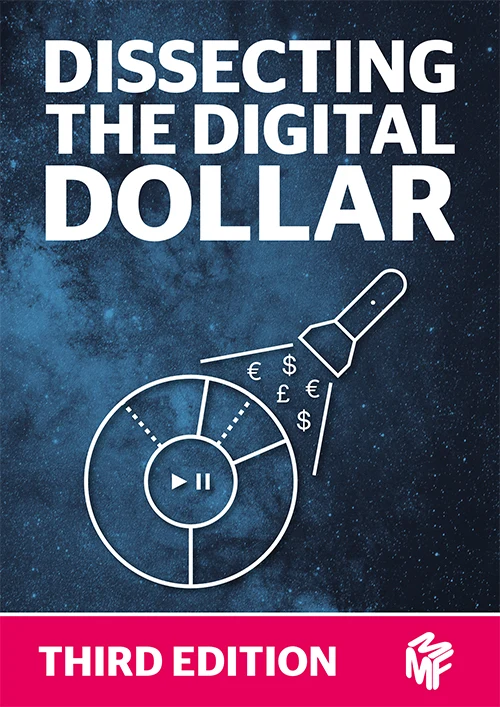
Dissecting The Digital Dollar
Where the proceeds go
Some book links on this site earn a commission. Every penny of it goes to the American Cancer Society.
The American Cancer Society funds cancer research, runs free patient-support programs, provides lodging for patients traveling for treatment, and staffs a 24-hour helpline. You do not need to buy a book to help.
This review contains affiliate links. As an Amazon Associate I earn from qualifying purchases, and all commission is donated — details on my disclosure page.