 Watch on YouTube
Almost everything written about the film business is written by people in it. This book is written by economists who are not, and that is precisely its value.
A Concise Handbook of Movie Industry Economics is a collection of academic essays applying formal economic analysis to the film industry — demand, pricing, contracting, distribution, market structure. It is dry. It is also the only place on this shelf where the claims come with methodology attached.
What the book actually covers
The volume is structured as a set of contributions from academic economists, each addressing an aspect of the industry with the tools of applied microeconomics and industrial organization.
The recurring subjects are the ones that matter commercially. The demand side: what actually drives audience behavior, how information cascades and word of mouth propagate, and why opening weekend carries the weight it does. Contracting: why the industry uses the revenue-sharing structures it does between distributors and exhibitors, and what problem those structures solve. Market structure: concentration, vertical relationships, and the effects of the antitrust history. Uncertainty: the formal treatment of the fact that outcomes are extremely difficult to predict — the academic version of William Goldman's "nobody knows anything," covered here.
What distinguishes it from the trade literature is that the assertions are tested. Where a practitioner book says stars drive box office, this asks whether the data supports it, under what conditions, and by how much. Frequently the answer is more qualified than the industry assumes.
It is a handbook, not a narrative, and it reads like one.
Why you should read it
Read it if you need to make an evidence-based argument about film economics. The trade press and the practitioner memoirs give you assertion and anecdote; this gives you findings with methods attached. In a room where everyone is confident and nobody is citing anything, that is a meaningful advantage.
Read it for the contracting chapters specifically. The distributor–exhibitor revenue-sharing arrangements, and the reasons the industry settled on them, are the kind of structural question that practitioners take as given and economists actually explain. Understanding why a contract has the shape it does is the beginning of knowing when it can be changed.
And read it as the rigorous end of a spectrum. Harold Vogel gives you the comprehensive sector reference. Edward Jay Epstein gives you the sceptical journalism. This gives you the peer-reviewed analysis. Between the three you can hold almost any position on film economics and defend it.
Key takeaways
- Industry folk wisdom is testable, and often fails. The star-power assumption in particular is more qualified in the data than in the room.
- Contract structures solve identifiable problems. Revenue-sharing between distributor and exhibitor exists for reasons that can be stated formally, not merely historically.
- Uncertainty can be modeled even when outcomes cannot be predicted. The academic treatment of unpredictability is more useful than the fatalistic version.
- Citations change arguments. For anyone arguing against consensus inside a company, this is the source of ammunition the trade press cannot provide.
Meet the editor

Charles C. Moul is an academic economist specializing in industrial organization, whose research has included applied work on the motion picture industry — the economics of distribution, exhibition and demand. He assembled this volume as a collection of contributions from researchers working on the sector.
The book was published by Cambridge University Press as part of its economics list, and is aimed at students, researchers and practitioners who want the formal treatment rather than the trade account.
Get your copy
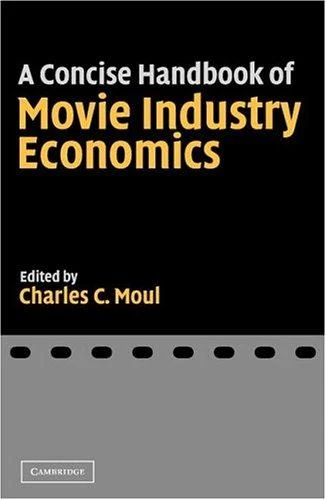
A Concise Handbook of Movie Industry Economics
Where the proceeds go
Some book links on this site earn a commission. Every penny of it goes to the American Cancer Society.
The American Cancer Society funds cancer research, runs free patient-support programs, provides lodging for patients traveling for treatment, and staffs a 24-hour helpline. You do not need to buy a book to help.
This review contains affiliate links. As an Amazon Associate I earn from qualifying purchases, and all commission is donated — details on my disclosure page.